
Air Duct Cleaning: Repair or Replace? How Highlands Ranch Homeowners Decide
Most Highlands Ranch homeowners who call us about duct work have already decided they need cleaning. The better first question is whether the ducts can hold the air you’re paying to push through them. Cleaning a leaky, half-crushed duct system is a real job, but it’s a job done on air you’re partly losing anyway. So here’s the framework we walk homeowners through, before anyone commits to clean, repair, or replace.
Why Duct Condition Comes Before the Cleaning vs. Replacement Decision
A duct system is not a set of pipes sitting quietly out of sight. It’s a sealed air pathway, and it only works when the seal actually seals. When we inspect a Highlands Ranch home, we’re looking at three things at once: how much debris has built up, how much air is escaping, and whether the duct structure itself can still do its job. Cleaning addresses the first item. Sealing and repair address the second and third. Skip those, and the debris comes back faster because unfiltered air is being pulled in through every gap. Treated as one decision rather than three, the math usually points clearly toward one path.
Approach the question in this order:
- Assess first. Get a duct leakage test and a video inspection before any cleaning quote is written.
- Compare leakage numbers to thresholds. Below 10% loss, cleaning alone is often the right call. Between 10% and 25%, sealing usually belongs in the job. Above 25% or with structural damage visible, you’re looking at repair or replacement.
- Match the fix to the fault. Not every problem is a sealing problem. Crushed flex and disconnected joints need physical repair, not sealant.
- Price all three options before deciding. Cleaning plus sealing, section replacement, and full replacement are three different budgets. Homeowners who compare only two of them tend to overspend in one direction or the other.
Our technicians have up to 14 years of experience, and the pattern that comes up most often in Highlands Ranch is builder-grade flex duct that’s been quietly losing air since the house was new. Getting the assessment right is what separates a worthwhile cleaning from a repeat visit in two years.
How to Read a Duct Leakage Test Result
A duct leakage test measures how much of your conditioned air escapes before it reaches a register. Typical residential systems lose a meaningful share of their airflow this way. The percentage is the number you build the decision around, and the thresholds below are the ones we use when we’re talking through a written assessment with a homeowner.
- Under 10% leakage: the duct system is holding air well. Cleaning is usually the right investment. A light sealing pass on accessible joints is a reasonable add-on, not a necessity.
- 10% to 25% leakage: cleaning alone leaves real money on the table. Duct sealing (mastic on accessible joints, or an aerosol-based sealant for the parts you can’t reach) typically belongs in the same visit as the cleaning.
- Above 25% leakage: the system is losing enough air that cleaning without sealing isn’t a good use of the money. This is the range where section repair or replacement starts to make financial sense.
- Above 30% with structural damage: full replacement of the affected duct run is usually the honest answer, especially on older homes where the material itself has reached the end of its life.
One caveat worth stating plainly: a leakage number is a starting point, not the whole picture. A system at 32% leakage with one crushed return line and otherwise sound trunk work may only need that section replaced. A system at 18% leakage with flex duct that’s collapsing in three places may need more than sealing can deliver. The test result plus the video walkthrough together are what tell you which path applies.
The Age and Material Fault Lines in Colorado’s Climate
Colorado’s dry air, big temperature swings, and long heating season wear duct materials in ways that matter for the repair-or-replace decision. The material in your walls tells you a lot about what to expect, regardless of how the house looks from the outside.
Galvanized steel duct is the most durable option and often outlasts the rest of the HVAC system when the seams and joints have been sealed and maintained. In a Highlands Ranch home with steel ductwork, the question is usually sealing and cleaning, not replacement. Flex duct, common in builder-grade construction, has a shorter service life. It crushes, sags, and the inner liner can separate from the outer jacket. In the dry Front Range climate, the plastic liner becomes brittle faster than in a humid region, and a crushed run of flex can cut off airflow to an entire room without any visible sign from the register. Fiberboard duct, used in some older installations, is vulnerable to moisture damage and tends to break down at the joints first.
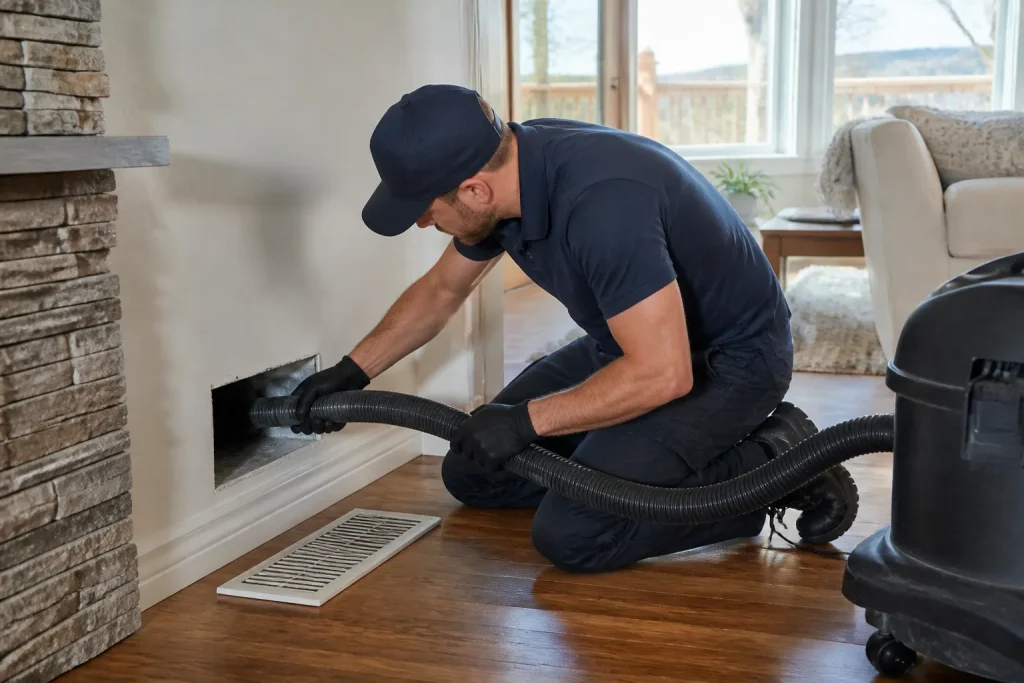
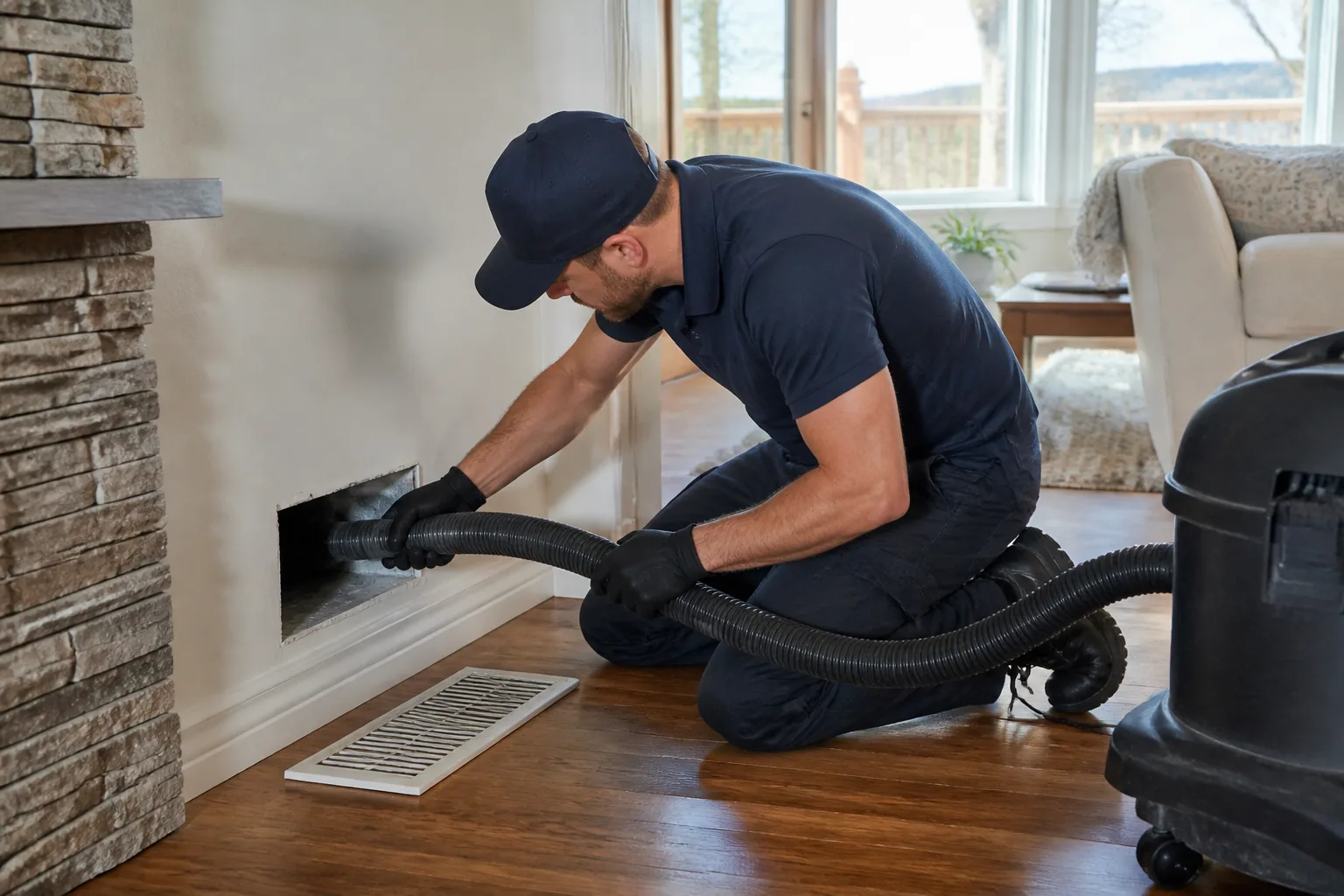
Our inspections look for the specific failure points: disconnected collars, crushed spans, separated inner liners on flex, and joint separation on steel. We use Rotobrush contact cleaning to lift debris from the duct walls rather than relying on air alone, and Nikro HEPA vacuum equipment to contain what comes loose. Abatement Technologies containment gear comes out when the situation calls for it. But no amount of professional equipment fixes a duct run that’s physically crushed. That’s a repair conversation, not a cleaning one.
What Duct Sealing Can Fix, and What It Can’t
Sealing is one of the most cost-effective improvements you can make to a duct system, but it has a clear ceiling. Mastic sealing handles accessible joints, seams, and connections at the registers or plenum. An aerosol-based sealant can reach small gaps in ductwork behind walls. What sealing cannot do is restore a duct that has physically lost its shape or its connection to the rest of the system.
Here’s the dividing line we walk homeowners through:
- Sealing is a good fit for: small joint gaps, seam leaks, minor register boot leaks, and any ductwork you can see and reach without demolition.
- Physical repair is required for: crushed flex runs, disconnected joints, collapsed trunk lines, and separated inner liners. No sealant bridges a gap that big.
- Section replacement is required for: a long run of damaged flex behind a wall or ceiling, or fiberboard duct that’s breaking down at multiple points.
- Full replacement is required for: extensive structural failure, contamination that cleaning can’t resolve, or a system so old and incompatible with the current HVAC setup that repair is throwing money at the wrong part.
For homes where filtration and humidity control belong in the same conversation, we can recommend and integrate Honeywell and Aprilaire products while the system is open and accessible. It’s one crew, start to finish, across Highlands Ranch air duct cleaning pros services that cover the full air pathway rather than just the ducts themselves.
Cost Comparison: Cleaning + Sealing vs. Section Repair vs. Full Replacement
Highlands Ranch homes range from smaller footprint builds to larger two-story plans, and the cost range reflects that. The numbers below are typical estimates for this market, not fixed prices. The written estimate after inspection sets the final figure.
| Option | Typical Range | When It’s the Right Call |
|---|---|---|
| Cleaning only | $400 – $1,000 | Leakage under 10%, duct material sound |
| Cleaning + sealing | $1,200 – $2,800 | Leakage 10% – 25%, no structural damage found |
| Section repair + cleaning | $1,800 – $4,500 | One or two damaged runs, rest of system sound |
| Full duct system replacement | $5,500 – $12,000+ | Leakage above 30% with structural failure, or system beyond its useful life |
Two things shift these numbers up or down. Larger homes with long duct runs cost more. Homes with attic or crawlspace access can be less expensive to work in than homes with ductwork buried behind drywall. The comparison only makes sense when all three options are priced against the same leakage test result and the same video walkthrough. Sealing against a 30% leak is money spent in the wrong place.
The Inspection Deliverable You Should Demand Before Any Decision
Before you authorize cleaning, repair, or replacement, ask for three specific things. Any contractor who can’t produce them is asking you to make a four-figure decision on a verbal opinion. In our experience, the contractors who deliver these documents are the same ones whose work holds up.
- Video footage of the duct interior. A before-and-after record of what’s actually inside the ducts, including the branches and returns, not just the main trunk.
- Leakage test data. Actual measured numbers, taken before any work starts. Without this, there’s no way to know whether sealing makes sense.
- A written condition assessment. A plain-language document that states the material type, the condition of each major run, the leakage figure, and a recommended path with the cost of each option.
That last item is where a lot of homeowners get the most value. A written assessment makes the comparison honest, because every option is priced against the same data. When it’s done well, the decision usually stops being complicated. Highlands Ranch homes with well-sealed, well-maintained duct systems get a cleaning. Homes with crushed flex and 28% leakage get the repair conversation. The assessment tells you which one you’re in.
When to call a pro: if you’re seeing inconsistent airflow between rooms, higher dust levels after a recent renovation, or you’ve moved into a home with no record of prior duct service, an inspection is the right starting point. It’s also the right call if you’ve had cleaning done before and the airflow problems came back. If you’re ready to schedule, reach out for a free estimate, or browse air duct cleaning details for what the inspection visit covers.
Related services in Highlands Ranch: HVAC cleaning for the unit-side of the air pathway, and dryer vent cleaning for the other air corridor most Highlands Ranch homes ignore.
The Bottom Line
The repair-or-replace decision starts with a duct leakage test and a video inspection, not a cleaning quote. Get the numbers first, then choose between cleaning only, cleaning plus sealing, section repair, or full replacement based on where your leakage falls. In Highlands Ranch, most homes land in the middle two categories, but the ones that need full replacement almost always show signs homeowners could have caught earlier with a proper assessment. If you’re in Highlands Ranch and need help sorting out which path applies to your home, Highlands Ranch Air Duct Cleaning Pros offers free estimates. Call (833) 513-8872. We answer 24/7. Fast dispatch from 7am to 7pm, Sunday through Friday.
Frequently Asked Questions
Typical estimates in Highlands Ranch run $400 to $1,000 for cleaning only, and $1,200 to $2,800 when sealing is included. Larger homes or homes with difficult duct access sit at the higher end. The written estimate after inspection sets the final price. Call (833) 513-8872 for an exact quote; estimates are free.
Lower quotes usually reflect less equipment, less time, and no inspection. A blow-and-go crew with a shop vac can show up, run air through the system, and leave without addressing leakage, structural damage, or debris in the branches. The number on the invoice looks better, but the cleaning isn’t the same product. When comparing quotes, ask for the leakage test, the video footage, and the written condition assessment. Call (833) 513-8872 for an exact quote on the full scope.
Ask for before-and-after video footage of your own ducts, plus the leakage test numbers taken before and after sealing. That’s the difference between a claim and a record. A cleaning you can’t verify is hard to defend when airflow problems return in a year. Call (833) 513-8872 to schedule an inspection and see the footage for yourself.
Most homes don’t need annual cleaning. A realistic interval is every three to five years, adjusted up for pets, recent renovation, or a home with unknown duct history. Homes that add sealing to the cleaning typically stretch that interval because less unfiltered air gets pulled into the system. Call (833) 513-8872 if you’re unsure where your home falls.
Written by the team at Highlands Ranch Air Duct Cleaning Pros.
Need Air Duct Cleaning Help?
Call Highlands Ranch Air Duct Cleaning Pros - the local pro we connect you with is licensed and insured, here with fast help in Highlands Ranch.
(833) 513-8872